author: Tyson Liddell
tags: capturing-composite-video-with-a-microcontroller
Let's see how much of a composite video signal, in this case from an old DVD player, can be retrieved using a Tiva C Launchpad (TM4C123GH6PM). This MCU is not a great choice for sampling such a signal: its ADC will not be able to keep up with the speed at which a CRT sweeps a scanline. However, a low resolution image might be possible if the signal is sampled as fast as possible.
Each scanline in a monochrome PAL video signal is made up of several sections:
The active video section lasts around 52 microseconds and contains the luminance information for the scanline displayed. Its voltage controls the brightness of the CRT beam in real time as each scanline is drawn, which makes composite video an analog process. The ADC of the TM4C123GH6PM has a max sample rate of 500 ksps, allowing 500000 * 52 * 10^(-6) = 26 samples per displayed scanline to be captured. This should provide enough data for a very low resolution image.
Colour is added to the legacy monochrome PAL signal with a high-frequency QAM (Quadrature Amplitude Modulation) subcarrier. This subcarrier contains only chrominance information, is added to the active video portion of the scanline, and must be used in conjunction with the baseband luminance signal to form a color image. A colourburst is added to the flat back porch of the legacy signal: this contains the QAM carrier reference phase necessary to demodulate the subcarrier signal.
The frequency of the chrominance subcarrier was determined by inspecting the colourburst with an oscilloscope. 4.43 MHz was observed, which is expected for a PAL signal. This is a problem for the microcontroller, because its ADC cannot sample this frequency fast enough. A passive RC low-pass filter was used to remove the chrominance subcarrier, while keeping the luminance signal intact. A 100 pF capacitor and 4.7 kOhm resistor results a cutoff frequency Fc of
Fc = 1/(2*pi*R*C) = 1/(2*pi*(100*10^(-12))*(4700)) ~ 340 kHz.
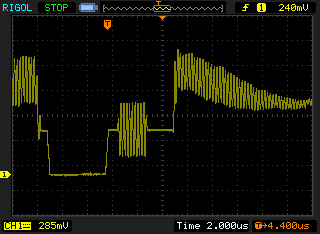
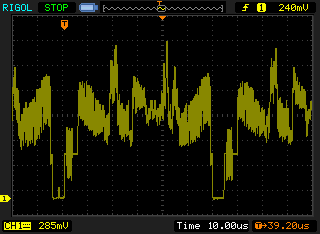
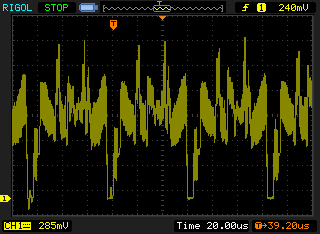
The chrominance subcarrier is clearly visible in the colourburst and active video sections of the unfiltered signal:
The low-pass filter appears to clean this up nicely:
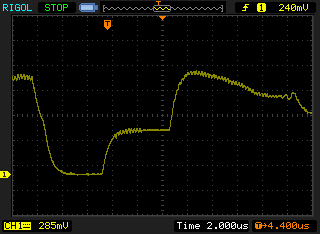
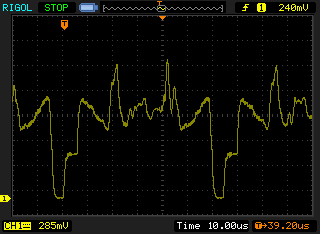
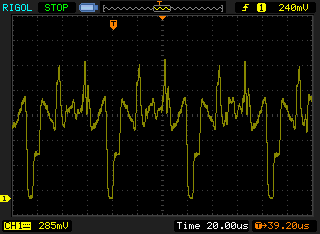
Hopefully, this filtered output provide a clear enough luminance signal to be read by the ADC of the MCU, and a black-and-white image can be retrieved.